Path, Trails & Threads:
Visualising Character and Identity of Real-World Place Mentions in Literature
This project is my Master's dissertation at The University of St.Andrews. The field of this project is information visualization. This research received a distinction.
Introduction
The use of information visualisation in the humanities has become increasingly popular. This visualization focuses on the sequence and physical distribution of place mentions in individual literary works and contributes a visualisation allowing the user to explore real-world Edinburgh locations mentioned in literary works without visiting the city. Users can explore places in the order in which they were mentioned in the literature and compare the geographical range and distance that individual literary works cover across Edinburgh. The implementation is mainly in d3.js. After the implementation, a questionnaire is used to evaluate the visualization.
Design Process (Some Sketches)
The main aims of this project are visualising the mentioned places and their order on a map and visualising (Arrows designed on maps) the linear sequence and latent spatiality of place names mentioned in the literature (Linear Sequence Design). Some sketches can be found as follow:
ARTEFACT PRODUCED
Three books are implemented for the prototype. The three famous Edinburgh books are selected from 10 of the best books set in Edinburgh reported by The Guardian: Trainspotting by Irvine Welsh (1993), The Private Memoirs and Confessions of a Justified Sinner by James Hogg (1824) and The Prime of Miss Jean Brodie by Muriel Spark (1961). Each book presents a distinct view of the city at different times in the history of Edinburgh. The books all have plenty of mentions of Edinburgh places and vary widely in term of style and themes. Trainspotting is a collection of short stories related to various residents of Leith, Edinburgh, with 121 mentions of Edinburgh locations. The Private Memoirs and Confessions of a Justified Sinner is an early example of modern crime fiction located in a historically definable Scotland, with 46 mentions of Edinburgh locations. The Prime of Miss Jean Brodie is an autobiographical based story about a Scottish woman, with 108 mentions of Edinburgh locations. These books were chosen in an attempt to visualise how the popularity of various Edinburgh locations in literature change over time.
There are two interfaces of this project. The initial interface allows the user to choose a book to visualise, as well as includes the aim of this project, the meaning of each visual variable, and the methods of interaction, which helps the user to have a better understanding of this visualisation.
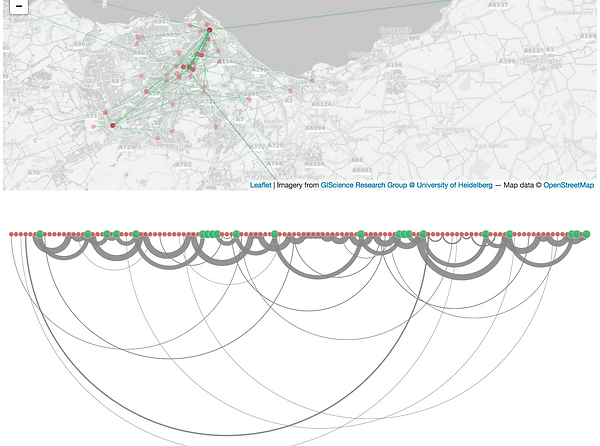
There are two views in visualization interface, map view and arc diagram. In the arc diagram, each dot represents once Edinburgh location mentioned in the book. The mentioning can be either a specific Edinburgh place (resulting in a red dot), e.g. ‘Royal Mile’, or just Edinburgh (resulting in a green dot). The rank of the dots is according to the mentioning order in each book. For example, in ‘Trainspotting’, the first place mentioned in Edinburgh is ‘Leith Walk’, the second is ‘Tollcross’, and the third is ‘Sighthill’. You can see the place names by mouse hovering over each dot. If the same place is mentioned at different times in the book, its dots will be linked by arcs. The width of the arc is set according to the mentioning time of each place.
Every place mentioned in Edinburgh can be found on the map above the arc diagram. When hovering over a dot in the arc diagram, the corresponding place will be shown on the map. Green lines link the location mentioned next in the book. The transparency of the place dot is set according to their mentioned times. When hovering over a dot on the map, the name of the place is displayed in a tooltip and its corresponding locations in the arc diagram will also be shown.
Visualization Interface
The interaction version of this project can be found in the following video.
Alternatively, you can go to my YouTube Channel to watch.
More Design: The Chapter and Page Number Instead of Just Sequence
The current visualisation helps the user to read the order of location mentions in the book, but the distance between mentions in the book still cannot be found in the visualisation. Two mentioned places which are next to each other does not necessarily mean they are close in the book (maybe they are in different chapters with much other content between them). Meanwhile, two mentioned places with three other mentions of them may be on the same page.
To help the user have a more detailed idea of the distance between mentions in the book, the visualisation can be improved by adding a chapter line. Bars with chapter segments use colours for identifying chapters. For example, there are six chapters in The Private Memoirs and Confessions of a Justified Sinner, so the chapter bar is divided into six segments. Each Edinburgh place mentioned links to its corresponding chapter. The location of the link depends on the mention location in the chapter. For example, when the place in Edinburgh is mentioned at the beginning of a chapter, the line links to the left part of the bar and the corresponding dot. When the mouse hovers over an individual chapter, the chapter segment will be amplified. When clicking the chapter bar, the sentences mentioning Edinburgh in this chapter will show up one by one in the tooltip. The user can read and select the sentences according to the mentioning order.
Chapter Detail Design
The poster of this project can be found here.


Demo